Roland Barthes

Paul Slocombes lecture was interesting as it supported the current project I am working on which involves the importance of semiotics. He began by going into discussion of semiotic terms, and the understanding and interpretation of signs. He developed my understanding in semiotics, in reference to two theories and principles by his hero Roland Barthes, these being mythologies and Camera Lucida.

Today we are paraded by myths and as visual communicators we need to take recognition on why this is happening

'The 'myths' which suffuse our lives are so insidious because they appear so natural..they call out for the detailed analysis which semiotics can deliver'

Roland Barthes suggests that myths have been manipulated for other purposes. Peoples perception of a product can change due to this mysterious belief or myth into what the product can do. People do not question this belief into a myth because it delivers the sense of being a true fact.

Take soap as an example. Soap is a product for cleansing and generally all soaps are made up form the same substance. However, today we have a range of soaps that have different uses because of the hidden myths behind its ingredients. The common myth is the idea of soap being a natural, organic substance. There is also a myth of the secret recipe. Developing a character suggests history behind the product. History adds quality and trust to the product as it delivers this false sense of the soaps 'secret recipe' being successful for so many years.


Advertising and packaging can help (exaggerate) peoples belief of a myth behind the product. As stated soaps can deliver the myth of organic and natural substance. So using recycled packaging adds to the feel of a environmentally friendly, natural, healthy product. Doing simple adjustments also adds quality and expense to the product. The audience is led to believe someone has taken time and effort to handcraft these soaps making them worthy to pay a bit more for.


Paul followed Rolands theory of mythologies by discussing the book he wrote Camera Lucida. Roland Barthes wrote about his reflections on photography.


'It is by studium that I'm interested in so many photographs, whether I receive then as political testonamy, or enjoy them as historical scenes for it is culturally and that I participate in the figures, the faces, the gestures, the settings, the actions'

By the term studium he refers to the field of cultural interest. He also mentions the word punctum, which simply refers to the part of the photograph that relates to you on an emotional level


Paul explored the photograph below showing Rolands participation and interest in the figures, faces, gestures, settings and actions. I found this photograph extremely powerful in support of Rolands quote. We assume that this is a family photograph from the way they are standing with each other and the age differences of the people. Looking at the parents dress sense and and the lady's full face of make up, we can see that the mother and father are young adults. From their attitude in their facial expressions and positioning with the children in the photograph we can see they are unhappy with the life they have led. The photograph tells a story of the un-expectancy of their children at such an early stage of their life and the want of their old lifestyle is shown through their emotion and appearance.


Vernacular Typography

David Osbaldestin delivered a useful and interesting presentation that explored into his hero So Me. I was already familiar with So me's work as he has been a huge influence on work I have previously created. Therefore it was extremely interesting to learn new things about So me that I did not know and consider before. I learnt and developed a deeper understanding into the history behind the work.

Many distinguish fine art and graphic communication as two seperate forms of practice. Fine art was and can still be seen as a high class, formal subject in comparison to graphic communication. David went into discussion in how he believes the two subjects can sit together and be respected equally.
Pop art represents the direct relationships between fine art and commercial work. Using Richard Hamilton as an example, pop artists had used the same principles as we do in graphic communication such as the same tools to make use of composition, hierarchy and layout. We were also shown work by Mark Titchner who had created a propaganda poster that originally produced for fine art practice could be viewed as a piece of advertising. The piece 'if you can dream it, you must do it' delivers bold graphic language in the form of a brand slogan which also can be seen as a interesting piece of typography.


He followed on to talk about his hero, making a relevant connection to how the two practices integrate and how his hero makes use of this. I took note of how he researched into past artists and art movements to show the understanding of his influences work and how he believed two subjects, fine art and graphic communication, can be performed as one.
His hero was discovered from the passion for the music by Ed Banger Records. They wanted to create a fresh new look, therefore invited graphic designer, So me to become the art director of Ed Banger Records, to  help create and deliver a strong product, service and company. This led David to the discovery of So me's work.

So me makes use of the term and practice vernacular typography, hand rendering his type in a style that can be recognised as So me. Vernacular is an everyday type which commonly has no set structure, because of its loose, natural, hand rendered form. Vernacular can also be seen as street art.
So me's type has strong character and using vernacular style allows them to be imaginative in their ideas. Every time a piece of vernacular typography attempts to be recreated, it will appear slightly different and you can see this process develop through So me's designs.

So me is extremely quick at shooting out ideas and producing new work. He has so many ideas from the adaptation of one piece. He will continue to develop a piece of his work which will help shift the idea to give it a new meaning.

At the moment, I am currently in the 3 three week changeover to 'Semiotics'. David talked about the semiotics behind some of So me's pieces, which helped me learn more about the importance of semiotics considered in a design. Take a piece from So Me's work, 'Mr Flash branding' as an example. It semiotic-ally works with the idea of an american identity. It contains several images to build a symbolic piece. The stars and colours red, white and blue can relate to the American Flag.
So me's vernacular type replicates the idea of prison tattoos. The image also suggests a relation to music from the choice of words, for example 'instrumental' and the position of hand that is similar to holding a guitar chord.


For my semiotics project I have considered the choice of images and words I use. I have also developed David's understanding of how fine art and graphic communication can combine.

FINE ART IN RVJ FOR SEMIOTICS put image in here

Artists with Issues

Today our lecturer was Vince Cross, who had previously studied illustration at BCU. Many of the previous lectures discussed commercial work; although this is my preferred study, it was interesting to see something different. He went into discussion on heroes who had major influences and inspiration to his lifestyle and work and artists who use novel approaches to issue based art.

Adrian Piper, is a conceptual artist who works across a range of media to pursue her idea. Today, Vince carried out the discussion into her influences on politics and her early work based on the street in 1970. One of the key aspects of the lecture that I was interested by was the work influenced by the issues targeted at herself and to show that being different cannot make you stand out but invisble to those around you, as those do anything to try and avoid and ignore you because of your individuality.


She went out into the public displaying her odd, unique presence to experience public responses to her actions. This involved activities such as covering herself in sticky white paint, wearing a wet paint sign. The work focused on the interaction between the artist and the public and the reaction of the individual to her presence which resulted in the theory of being different can make you invisble.

Another project that supported this statement, was the work she carried out in relation to her personal concerns on racism. Work that explores her concern include a pencil drawing of a self portratit which exaggerates her 'negro' features. First you see the work as a highly detailed drawing although the supported statement reveals the concept and idea. The statement below the drawing puts an entirely new view on the piece, and also opens questions to what she really may look like.


Romare Bearden, The Family
She experienced that the majority of people who passed her did not recognise her background, therefore a lot of racist remarks were said around her with no support of her concern and the offence she could take. Therefore to raise racial awareness, she created calling cards like the one on the left. These were handed out at events, again to observe peoples reaction and to identify how someone who is different can appear invisible.


Another influence Vince had discussed was Jenny Holzer who worked similarly to Adrian Piper although was not as confrontational and her work performed more like poetry. She was also a conceptual artist who worked around her interest in politics. Her influence and style was similar to Mark Rothko. What he had created with paint was what she had explored with words.

Holzer looked for new ways to make narrative or commentary an implicit part of visual objects. She uses mass media and marketing techniques to challenge our attitudes and values. She displayed 'truisms' around New York such as the phrase, 'Abuse of power comes no surprise' and was commonly used on t-shirts as well as around Time Square.


It was inspiring to see that her work functioned and performed in the same way as an advertisement even though it was not neccesarily created for that purpose. The work she had created was wrote in the perspective of the victim or observer; it was the voice of the people. If the public had the tools to advertising and the opportunity to present their word, this is what they may say. It was up to the public to agree or disagree with her judgments.
The phrase used below challenges and questions the freedom of capitalism.


After discussing these heroes, he presented a video by Devo again active in 1970s. The purpose of Devo, is to show that mankind is not evolving but devolving. The video shows that helpful ideas can be presented in a fun, innovative way. The video presents the theory that as much as people try to be individual, all man kind can end up being the same. The video also portrays the idea of people having to make a 'false choice', presenting two objects that they may not want either of in comparison to making a real choice.

I learnt from Vince and his heroes, that a strong visual combined with a strong concept produces a strong, meaningful piece of art or design. It is easy to produce something that looks good, but if there is no concept or idea behind the piece it will not be as satisfying to your audience.

The creative revolution in advertising

Today's ITAP lecture followed from last week continuing the discussion into advertising where Clive introduced us to to the inspiration and history behind his heroes.

Bernbach was a major force behind the creative revolution, from 1954 to 1964. He was one of few art directors at the time, to have the ability and confidence to change design of today. Before the creative revolution, many commercial artists focused upon how the advertisement looked. Therefore there was a lack of thought into the concept and ideas behind the design.. Jay Walter Thompson was the man behind these layouts. They were very predictable and meaningless and our audience needed a change.
Commercial artists did not make the connection between the text and image for it to communicate effectively with the audience. Therefore, Bernbach introduced the idea of the concept into advertising communication. To do this he made the successful decision on developing a team of copywriters and art directors, combining both areas of strength.

People wanted to live up to the american dream of living a large and luxury lifestyle with fancy cars. In reality, it was not possible or affordable.


Bernbach worked with a team that identified problems and were willing to take risks to solve them. It was noticed that the ad agency's were becoming too comfortable with selling in their own area. DDB confronted the task of breaking this tradition and selling a German car into the New York Market. American citizens needed affordable, reliable products and this was Bernbach's chance to adjust their lifestyle for the better through advertising.
As discussed, the old JWT layouts were busy and not very creative so DDB advertised the Volkswagen with a simple, minimal but meaningful layout. Simplicity had never been done before.


The Volkswagen adverts did not state the obvious and instead had a concept and idea behind it that intrigued their audience. There is a relationship between the image and its supported text, that is simply witty and playful with the stereotypical idea of the big american dream car. The negative space allowed your mind to be free from distractions, therefore your main focus was on the image of the product.

I learnt that it is important to know history to help develop your understanding and create something new. It is inspiring to see theory created so long ago is still being used in the design world of today. There has been several developments in the design industry since 1960s, but I learnt from today that design had changed due to just one idea, which is possible now.

I researched more into the creative revolution and came across Leo Burnett, who was also heavily involved in the creativity of the 1960s who focused upon similar principles. He also concentrated on making his advertisements simple but also memorable.


I have involved the theory generated from the creative revolution into my work. I am currently in the three week changeover to 'design and composition' with Balvir where the task is to create a poster for an 'ism' word of our choice. I have considered the idea of simplicity within my design making use of negative space so there is full concentration on the meaning of the 'ism' word. I have also made a clear relationship between the image and text.

(picture of ism poster design)

Type is visual language

Balvir discussed the process and journey of discovering his hero, R.K Joshi and the mutual interest they had on visual language. R.K.Joshi was a friend, mentor and hero. I learnt that when discovering my own hero it does not necessarily have to be someone well known in the design world. The hero that is chosen needs to mean something to you and influence your life and work style. It may be you have a similar interest in a certain area of design.


Language is our first form of communication, then we develop this language into a visual form called type. We can adjust the type to help it communicate with others that do not understand. Whether this being due to the language barrier or our attitude towards a piece of writing. When you read something you read it in your own language whether or not it has been written by someone who speaks differently. Therefore it is common to interpret the message in a different way. Balvir mentioned that it was common practice for a design company to take the attitude of talking to you in person rather than through the form of digital communication such as email.

Joshi worked in different continents and even if he did not speak the language, he understood the design form by research and constant contact with speaking and listening to people.
He kept in regular contact with Balvir. Bal encouraged us to challenge our thinking and get in touch with our heroes. This made me consider getting in touch with my hero as I could work for their company one day. He kept in contact by letter, writing to each other when they could.

Language is our first form of communication and we need our language to enable us to write making writing the first step to visual language. Bal quoted Fernard Baudin 'the ability to write is the initial step towards any further development of the individual as a fully fledged citizen in a modern democracy'. which supports and explains how writing is the first step in visual language.
Visual language can not only be in the form of hand lettering but also in the form of pictures of sound. For example music notation is a visual form of sound which creates a typographic language of its own.

R.K Joshi was an academic type designer and calligrapher who created the core Indian fonts in Microsoft Windows. Balvir showed us some of R.K Joshi's pieces that involved inspiring typography, some that varied in calligraphy styles. In the lecture I learnt calligraphy was the basis of all typography. Below are some of the inspiring core fonts R.K.Joshi had created.


R.K.Joshi was not just known and successful for his work, but the inner thinking and theory behind the work. This goes for all famous design heroes.

Simple but different

Everyday we are bombarded with complexity therefore to stand out simplicity is the key. It is common for a  designer to want to put all their ideas onto one page. The key to a successful designer is to have the ability to select the best of those ideas, subtracting the unnecessary to a point where you are left with a simple, memorable design. There is a good and bad simple to every design. A bad design does not necessarily mean it is not able to communicate the message, but instead is not able to deliver the message in a fun, innovative way that your audience will remember. A good, simple design will convey a message in a clever way that does not follow your expectations.
Ros Sinclar delivered the presentation focused on her area of practice and main interest, advertising. It is also one of my own interests and I was intrigued to learn about practitioners in this area and how their work followed the rule of simplicity.

Ros briefly summerised how Doyle Dane Bernach had changed the face of advertising by introducing this idea of simplicity to adverts. The adverts were not full of irrelevant information and in this case less was more. The adverts were simply clever showing a relationship between a short piece of text and one image. The effectiveness of simplicity was created by the use of negative space and position of text and image.


As a graphic designer, you need to be prepared to take risks. Whether it means taking risks in the process for the design, or the risk of the reaction to your design. Creative Director, Juan Cabral is a perfect example. Juan Cabral is a well known film director known for directing several memorable television commercials such as the Cadbury's 'Gorilla Advert' and 'Sony Bravia 'paint', 'balls' and 'rabbit' adverts.

In the lecture we were shown one of the inspiring television advertisements for Bravia television created by Juan. I looked further into behind the scenes, discussing the reasons of the ad, the process, the element of risk, and their competition. You need to have consistent contact and a firm relationship with your competition in order to be different. Research into what the design world has to offer and how you could be different and make change for the future.

Juan Cabral develops a simple idea into a big production to give it a memorable message. There is complexity in the production but the idea is kept simple. The combination of the simple concept and eye catching imagery is what makes his work so effective.


A graphic designer in advertising has the capability to be confident to approach the right practitioner's to assist the process of their idea, and make their vision come alive. The perfomance could have gone horribly wrong, but with the right team of creative minds the advertisement is shot beautifully.

I have decided to look at Juan Cabrals work for other Bravia television adverts, and analyse what he does to makes his work so effective. Take the Bravia 'rabbits' advert, the concept of having friendly, colourful rabbits in contrast with the setting of a urban city landscape makes you think that this rush of colour can improve anything, in this case your television. He is also clever in the way he combines and relates the choice of music to the imagery. In this advert the song played is 'shes a rainbow' pushing the importance and excitement of colour.

A key feature in advertising is story telling. We were introduced to Hegarty who quoted 'Storytelling is the simplest ,most memorable device for engaging , learning , entertaining and persuading. It’s not surprising then that so many great ad campaigns adopt this simple device.'  Telling a story that the consumer can relate to will also form a stronger relationship with your audience. The Levi's 'launderette' advert was well known for its simple story telling. The audience was able to remember the story because of its retro feel and its simple humour. The story line was also something different and unexpected. The advert ended up relating to peoples everyday lifestyle, as people would copy the story line of washing jeans in the washing machine to shrink fit them in the stylish way Levis did.


Information Graphics

Colette is a information designer who's preferred study is discovering way finding solutions. Today, she talked to us about information design with relevant connections to her hero's in support of her words.

Information design surrounds and helps us with our everyday lives. Information would be too complex for people to understand if it was not designed in a suitable structural form. The complex information is made simpler which is dependent on the choice of colour's, type, various weights etc. Colette taught and advised us to learn the following theory when designing for information. To help simplify and organise the information, we need to consider the word LATCH, location, alphabet, time, category or type and hierarchy.
As a graphic designer we should be aware of our surroundings and how design has contributed to make our lives easier. Doing this will help build a stronger understanding into what has already been done and what new needs to be created.

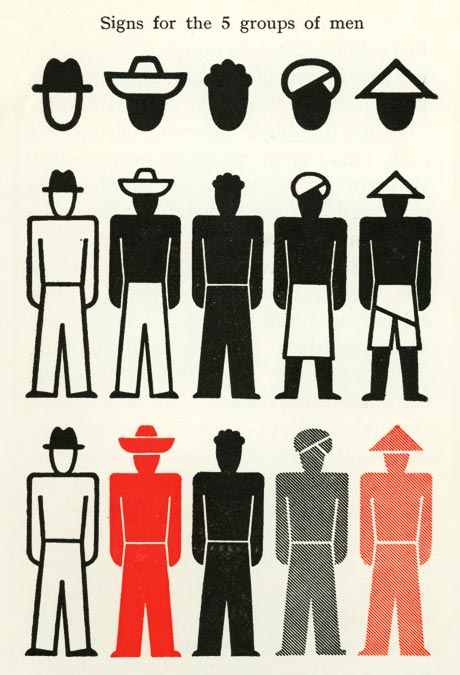
Colette quoted many information designers that inspired her. Otto Neurath, information designer, simplifies complex information through design. He's extremely knowledgeable on how information needs to be put in an understandable form. Neurath developed the 'iso system'. An isotype is a method of showing social, technological, biological and historical information in a pictorial form. He considers the use of shape, line and colour to create simple design similar to the LATCH system as discussed earlier.
Here is a piece of work showing the design considerations used to put information into a pictorial form. He uses a variety of shapes to create hats that represent types of men from different cultures. He also considers colour and line to help distinguish each culture.


She had also referred to Neville Brody as one of her heros. At the beginning of the lecture, we were shown an inspiring clip of an interview with himself and David McCandless that talked about the idea  of 'beautiful information'. Neville Brody mentions that there is a danger of making information too pretty. Beautiful information can over power the original purpose and use of information design. It can fail to be understood clearly and simply, and therefore could be seen as a piece of art rather than information design.


Collette advised us to think about designing for information when creating our blogs. Our blogs need to be clear and understandable in terms of design as well as content. Therefore the hierarchy, use of colour, simplicity of layout and position and choice of images need to be considered and suitable. It may be a useful idea to consider the word LATCH as previously discussed.