Today we are paraded by myths and as visual communicators we need to take recognition on why this is happening
'The 'myths' which suffuse our lives are so insidious because they appear so natural..they call out for the detailed analysis which semiotics can deliver'


'It is by studium that I'm interested in so many photographs, whether I receive then as political testonamy, or enjoy them as historical scenes for it is culturally and that I participate in the figures, the faces, the gestures, the settings, the actions'
By the term studium he refers to the field of cultural interest. He also mentions the word punctum, which simply refers to the part of the photograph that relates to you on an emotional level
Paul explored the photograph below showing Rolands participation and interest in the figures, faces, gestures, settings and actions. I found this photograph extremely powerful in support of Rolands quote. We assume that this is a family photograph from the way they are standing with each other and the age differences of the people. Looking at the parents dress sense and and the lady's full face of make up, we can see that the mother and father are young adults. From their attitude in their facial expressions and positioning with the children in the photograph we can see they are unhappy with the life they have led. The photograph tells a story of the un-expectancy of their children at such an early stage of their life and the want of their old lifestyle is shown through their emotion and appearance.

Roland Barthes suggests that myths have been manipulated for other purposes. Peoples perception of a product can change due to this mysterious belief or myth into what the product can do. People do not question this belief into a myth because it delivers the sense of being a true fact.
Take soap as an example. Soap is a product for cleansing and generally all soaps are made up form the same substance. However, today we have a range of soaps that have different uses because of the hidden myths behind its ingredients. The common myth is the idea of soap being a natural, organic substance. There is also a myth of the secret recipe. Developing a character suggests history behind the product. History adds quality and trust to the product as it delivers this false sense of the soaps 'secret recipe' being successful for so many years.

Advertising and packaging can help (exaggerate) peoples belief of a myth behind the product. As stated soaps can deliver the myth of organic and natural substance. So using recycled packaging adds to the feel of a environmentally friendly, natural, healthy product. Doing simple adjustments also adds quality and expense to the product. The audience is led to believe someone has taken time and effort to handcraft these soaps making them worthy to pay a bit more for.

Paul followed Rolands theory of mythologies by discussing the book he wrote Camera Lucida. Roland Barthes wrote about his reflections on photography.
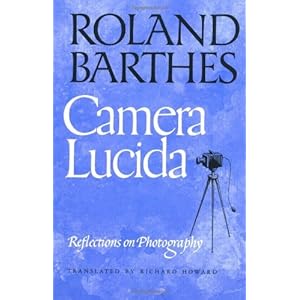
'It is by studium that I'm interested in so many photographs, whether I receive then as political testonamy, or enjoy them as historical scenes for it is culturally and that I participate in the figures, the faces, the gestures, the settings, the actions'
By the term studium he refers to the field of cultural interest. He also mentions the word punctum, which simply refers to the part of the photograph that relates to you on an emotional level
Paul explored the photograph below showing Rolands participation and interest in the figures, faces, gestures, settings and actions. I found this photograph extremely powerful in support of Rolands quote. We assume that this is a family photograph from the way they are standing with each other and the age differences of the people. Looking at the parents dress sense and and the lady's full face of make up, we can see that the mother and father are young adults. From their attitude in their facial expressions and positioning with the children in the photograph we can see they are unhappy with the life they have led. The photograph tells a story of the un-expectancy of their children at such an early stage of their life and the want of their old lifestyle is shown through their emotion and appearance.


No comments:
Post a Comment